 TARA's 2007 RTTY Mêlée Contest Voted "Best Digital Contest"
TARA's RTTY Mêlée Contest has received the "Best Digital Contest Award" for 2007 from the Digitalradio News Group owned/operated by Andy, K3UK. This group is an extremely large group that is totally dedicated to all aspects of digital radio communications. Its owner is a very well know digital enthusiast and his skills in the field of digital communications are quite extensive. This is the 4th Annual Awards presentation that Andy has done and all of us from TARA can't thank him enough for his acknowledgement of our Mêlée contest.
TARA's New Digital Awards Program..."Distinctively Different!"
If you're into digital communications do we have great news for you. TARA now sponsors a complete selection of "world class" digital awards that we're sure you'll find most challenging.
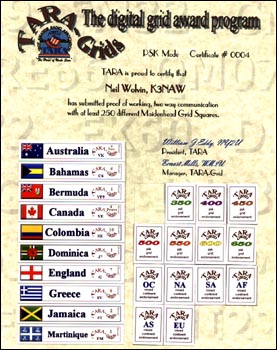
Our club now has the TARA-Grid - Digital Maidenhead Grid Award Program which I'm sure many of you might even qualify for right now. The TARA-Grid Award is an excellent companion to our All Seasons, Grid-Dip Contest. All contest entries qualify for inclusion in our TARA-Grid Award. You need only 300 different four (4) digit Grid Squares to claim your Basic certificate.
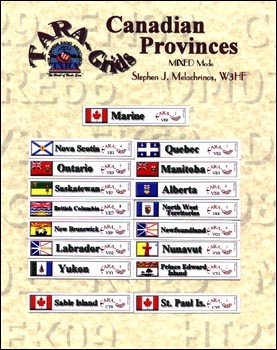
Next, we have the TARA-PX Award Program. TARA wants to recognize the achievements of Amateur Radio Operators world wide, for confirming two way communications by offering it's new Digital Prefix Awards Program. This award is available in MIXED, RTTY and PSK but more are coming out! And, we offer other awards like the Wet Award, TARA D-WAS, Canadian Award & the TARA-DDXCC. But wait...there are a few more!
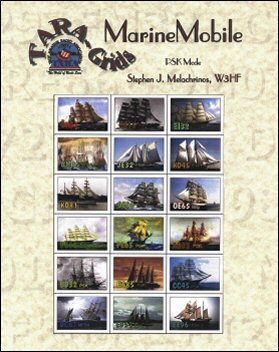
TARA invites you right now to review our new "World Class" Digital Awards Program. Come check out the complete line of custom certificates that we've designed especially for this program and we believe you'll see why we think they're "Distinctively Different." Please CLICK HERE to view these awards.
 |
Late Breaking News From The T.W.I.A.R. Newsroom


 Attention All Amateurs...
 Field Day Station Locator Up and Running
(Apr 5, 2008)
-- This year, for the first time, the ARRL has put together a Station Locator to help amateurs or those interested in Amateur Radio find a Field Day site near them. According to ARRL Field Day Manager Dan Henderson, N1ND, many amateurs have been asking for something like this for many years: "So far, 287 groups in 45 states and 3 Canadian provinces had registered their Field Day site with the Station Locator." If your group would like to be a part of the Station Locator Service, it's easy to get started. Just go to the Field Day Station Locator Web site and follow the instructions.
Field Day Station Locator Up and Running
(Apr 5, 2008)
-- This year, for the first time, the ARRL has put together a Station Locator to help amateurs or those interested in Amateur Radio find a Field Day site near them. According to ARRL Field Day Manager Dan Henderson, N1ND, many amateurs have been asking for something like this for many years: "So far, 287 groups in 45 states and 3 Canadian provinces had registered their Field Day site with the Station Locator." If your group would like to be a part of the Station Locator Service, it's easy to get started. Just go to the Field Day Station Locator Web site and follow the instructions.
Link to this item
|
 Feature: "Celebrate Life" Runner and Chicago Ham Bring Music To Armenia
(Apr 4, 2008)
-- In 2003, I celebrated my 60th birthday and recovery from cancer by running some 880 miles -- and giving concerts along the way across the American Midwest. Celebrate Life Run was documented extensively both on my Web site and on the ARRLWeb.
Feature: "Celebrate Life" Runner and Chicago Ham Bring Music To Armenia
(Apr 4, 2008)
-- In 2003, I celebrated my 60th birthday and recovery from cancer by running some 880 miles -- and giving concerts along the way across the American Midwest. Celebrate Life Run was documented extensively both on my Web site and on the ARRLWeb.
Full Story
|
 The K7RA Solar Update
(Apr 4, 2008)
-- The past few days have had very stable geomagnetic conditions. After unsettled to active geomagnetic indicators on March 26-28, conditions quieted down dramatically. Combined with the nearly two-week run of sunspots and the spring season, this makes good HF conditions. There were actually three sunspots, beginning on March 23 with the first one and a sunspot number of 14. March 24 and 25 each brought one new spot; the sunspot number rose to 35 and 52 on those days. Activity peaked between March 26-29 with daily sunspot numbers of 63, 57, 63 and 50. Yesterday, April 3, the sunspot number was back to 14 again, as one-by-one, the three spots drifted from view. Today's sunspot number may be back to zero, and it may stay that way until April 18-20. Sunspot numbers for March 27 through April 2 were 57, 63, 50, 41, 45, 25 and 24 with a mean of 43.6. The 10.7 cm flux was 84.8, 82.9, 82.6, 80.5, 79.2, 77.8 and 75.9 with a mean of 80.5. Estimated planetary A indices were 31, 21, 8, 8, 4, 4 and 1 with a mean of 11. Estimated mid-latitude A indices were 19, 13, 6, 6, 2, 5 and 1, with a mean of 7.4.
The K7RA Solar Update
(Apr 4, 2008)
-- The past few days have had very stable geomagnetic conditions. After unsettled to active geomagnetic indicators on March 26-28, conditions quieted down dramatically. Combined with the nearly two-week run of sunspots and the spring season, this makes good HF conditions. There were actually three sunspots, beginning on March 23 with the first one and a sunspot number of 14. March 24 and 25 each brought one new spot; the sunspot number rose to 35 and 52 on those days. Activity peaked between March 26-29 with daily sunspot numbers of 63, 57, 63 and 50. Yesterday, April 3, the sunspot number was back to 14 again, as one-by-one, the three spots drifted from view. Today's sunspot number may be back to zero, and it may stay that way until April 18-20. Sunspot numbers for March 27 through April 2 were 57, 63, 50, 41, 45, 25 and 24 with a mean of 43.6. The 10.7 cm flux was 84.8, 82.9, 82.6, 80.5, 79.2, 77.8 and 75.9 with a mean of 80.5. Estimated planetary A indices were 31, 21, 8, 8, 4, 4 and 1 with a mean of 11. Estimated mid-latitude A indices were 19, 13, 6, 6, 2, 5 and 1, with a mean of 7.4.
Full Story
|
 AES Superfest a Super Success
(Apr 4, 2008)
-- ARRL Sales and Marketing Manager Bob Inderbitzen, NQ1R, attended the 14th Annual AES Superfest at the headquarters store of Amateur Electronic Supply in Milwaukee, Wisconsin March 28-29. This event is an ARRL sanctioned hamfest that included forums, VE testing (sponsored by MRAC), DXCC card checking and a fox hunt. ARRL Central Division Director Dick Isely, W9GIG; Vice Director Howie Huntington, K9KM, and ARRL Wisconsin Section Manager Don Michalski, W9IXG, were also on hand for the event.
AES Superfest a Super Success
(Apr 4, 2008)
-- ARRL Sales and Marketing Manager Bob Inderbitzen, NQ1R, attended the 14th Annual AES Superfest at the headquarters store of Amateur Electronic Supply in Milwaukee, Wisconsin March 28-29. This event is an ARRL sanctioned hamfest that included forums, VE testing (sponsored by MRAC), DXCC card checking and a fox hunt. ARRL Central Division Director Dick Isely, W9GIG; Vice Director Howie Huntington, K9KM, and ARRL Wisconsin Section Manager Don Michalski, W9IXG, were also on hand for the event.
Full Story
|
 Feature: Surfin': Whispering on 30 Meters
(Apr 4, 2008)
-- This week, we surf to a Web site that offers a new soundcard-based digital mode that will have you whispering.
Feature: Surfin': Whispering on 30 Meters
(Apr 4, 2008)
-- This week, we surf to a Web site that offers a new soundcard-based digital mode that will have you whispering.
Full Story
|
 DXCC Working on 2008 Applications; St Barts Added to DXCC List
(Apr 3, 2008)
-- ARRL DXCC Manager Bill Moore, NC1L, reports that DXCC has completed processing applications for 2007. As such, St Barthelemy (FJ) has been added to the DXCC computer system and Logbook of The World (LoTW). With the addition, this moves the #1 Honor Roll position to 338 current entities; operators now need 329 entities to qualify for Honor Roll. "While DXCC has completed applications for 2007, there are a number of application returns still being mailed, so it may be another 2-3 weeks before applicants receive their 2007 return," Moore said. "LoTW is now accepting certificate requests for St Barthelemy; once those logs are submitted, the matches should occur and applicants can claim DXCC credit." For programmers who use the DXCC entity numbering system, the entity code for St Barthelemy is 516.
DXCC Working on 2008 Applications; St Barts Added to DXCC List
(Apr 3, 2008)
-- ARRL DXCC Manager Bill Moore, NC1L, reports that DXCC has completed processing applications for 2007. As such, St Barthelemy (FJ) has been added to the DXCC computer system and Logbook of The World (LoTW). With the addition, this moves the #1 Honor Roll position to 338 current entities; operators now need 329 entities to qualify for Honor Roll. "While DXCC has completed applications for 2007, there are a number of application returns still being mailed, so it may be another 2-3 weeks before applicants receive their 2007 return," Moore said. "LoTW is now accepting certificate requests for St Barthelemy; once those logs are submitted, the matches should occur and applicants can claim DXCC credit." For programmers who use the DXCC entity numbering system, the entity code for St Barthelemy is 516.
Link to this item
|
 ARRL DXCC Desk Approves G4GIR/KH9 Operation
(Apr 2, 2008)
-- ARRL DXCC Manager Bill Moore, NC1L, reports that the 2007 G4GIR/KH9 DXpedition to Wake Island has been approved for DXCC credit. "If you had cards rejected for this operation, please send an e-mail to the ARRL DXCC Desk to have your DXCC record updated," Moore said.
ARRL DXCC Desk Approves G4GIR/KH9 Operation
(Apr 2, 2008)
-- ARRL DXCC Manager Bill Moore, NC1L, reports that the 2007 G4GIR/KH9 DXpedition to Wake Island has been approved for DXCC credit. "If you had cards rejected for this operation, please send an e-mail to the ARRL DXCC Desk to have your DXCC record updated," Moore said.
Link to this item
|
 Feature: ARRL In Action: What Have We Been Up To Lately?
(Apr 2, 2008)
-- This feature -- including convenient Web links to useful information -- is a concise monthly update of some of the things ARRL is doing on behalf of its members. This installment covers the month of March.
Feature: ARRL In Action: What Have We Been Up To Lately?
(Apr 2, 2008)
-- This feature -- including convenient Web links to useful information -- is a concise monthly update of some of the things ARRL is doing on behalf of its members. This installment covers the month of March.
Full Story
|
Exhibit Kits Now Available for Field Day
(Apr 2, 2008)
-- Please visit our Field Day information page for all the details on Field Day rules, frequencies, forms, pins, logos and T shirts. The complete Field Day packet can be downloaded from the site as well. If you have unanswered questions about Field Day, contact ARRL Field Day Manager Dan Henderson, N1ND, via e-mail or by phone at 860-594-0236. If you want to order exhibit kits containing printed flyers about Amateur Radio, you may order these materials on the ARRL Web site. The cost of the exhibit kits ranges from $8-$12 depending on shipping. To make sure you'll have the display material in time for Field Day, your order must be received before June 13.
Link to this item
|
 New Editions of The ARRL Repeater Directory Now Shipping
(Apr 2, 2008)
-- With more than 20,000 listings for VHF/UHF repeaters across the US and Canada, The ARRL Repeater Directory 2008-2009 is a must have. Once again, the ARRL is offering two sizes of the Repeater Directory -- pocket size and desktop. This year, not only is the pocket-sized Repeater Directory a half-inch larger than previous editions, it boasts a larger font size, making for easier reading. For the first time ever, this year's editions feature handy indexing tabs on the cover, easier to read listings and a "Key to Repeater Notes" located right up front in the Directory. Along with these new features, both editions have the features you know and enjoy from prior years: Repeater operating practices, repeater lingo and hints for newly licensed hams; Frequency Coordinator contact information; listings for D-Star and APCO 25 repeaters; a guide to using CTCSS tones and Digital Coded Squelch (DCS); VHF/UHF band plans and a 2 meter channel-spacing map; IRLP (Internet linked) nodes; tips for handling interference; listings for IRLP, WIRES-II and EchoLink (Internet linked) nodes; emergency message handling procedures, and a transceiver memory log. Order your copy of The ARRL Repeater Directory 2008-2009 today at the ARRL Online Store.
New Editions of The ARRL Repeater Directory Now Shipping
(Apr 2, 2008)
-- With more than 20,000 listings for VHF/UHF repeaters across the US and Canada, The ARRL Repeater Directory 2008-2009 is a must have. Once again, the ARRL is offering two sizes of the Repeater Directory -- pocket size and desktop. This year, not only is the pocket-sized Repeater Directory a half-inch larger than previous editions, it boasts a larger font size, making for easier reading. For the first time ever, this year's editions feature handy indexing tabs on the cover, easier to read listings and a "Key to Repeater Notes" located right up front in the Directory. Along with these new features, both editions have the features you know and enjoy from prior years: Repeater operating practices, repeater lingo and hints for newly licensed hams; Frequency Coordinator contact information; listings for D-Star and APCO 25 repeaters; a guide to using CTCSS tones and Digital Coded Squelch (DCS); VHF/UHF band plans and a 2 meter channel-spacing map; IRLP (Internet linked) nodes; tips for handling interference; listings for IRLP, WIRES-II and EchoLink (Internet linked) nodes; emergency message handling procedures, and a transceiver memory log. Order your copy of The ARRL Repeater Directory 2008-2009 today at the ARRL Online Store.
Link to this item
|
 ARRL Compiles Complete Works of Larson E. Rapp, WIOU
(Apr 1, 2008)
-- Thanks to the tireless efforts of ARRL volunteer Bob Allison, WB1GCM, the League has assembled the complete known works of noted QST author Larson E. Rapp, WIOU. Rapp's remarkable contributions spanned a period of more than three decades (1941-1962, 1972), primarily during the month of April. Like most visionaries unafraid of pushing technology beyond conventional limitations, Rapp at times was controversial among his peers and contemporaries. ARRL Lab Engineer Mike Gruber, W1MG, said, "You can now be the judge of just how well Rapp's theorems and trademark 'radical approach' have withstood the test of time." Rapp himself said that "In assembling this list of my articles and letters over the years, I noticed that QST always chose to publish them in the springtime. This practice was especially meaningful to me as spring has historically been a time of new beginnings and in our radio hobby, a time for new insights into old technical problems. I hope you, too, will be helped and inspired by these writings of an old ham."
ARRL Compiles Complete Works of Larson E. Rapp, WIOU
(Apr 1, 2008)
-- Thanks to the tireless efforts of ARRL volunteer Bob Allison, WB1GCM, the League has assembled the complete known works of noted QST author Larson E. Rapp, WIOU. Rapp's remarkable contributions spanned a period of more than three decades (1941-1962, 1972), primarily during the month of April. Like most visionaries unafraid of pushing technology beyond conventional limitations, Rapp at times was controversial among his peers and contemporaries. ARRL Lab Engineer Mike Gruber, W1MG, said, "You can now be the judge of just how well Rapp's theorems and trademark 'radical approach' have withstood the test of time." Rapp himself said that "In assembling this list of my articles and letters over the years, I noticed that QST always chose to publish them in the springtime. This practice was especially meaningful to me as spring has historically been a time of new beginnings and in our radio hobby, a time for new insights into old technical problems. I hope you, too, will be helped and inspired by these writings of an old ham."
Link to this item
|
 Feature: It Seems to Us: Imaginary Numbers
(Apr 1, 2008)
-- One of the most frustrating aspects of dealing with the issue of radio interference from broadband over power line (BPL) technology has been the irrational boosterism of the federal government.
Feature: It Seems to Us: Imaginary Numbers
(Apr 1, 2008)
-- One of the most frustrating aspects of dealing with the issue of radio interference from broadband over power line (BPL) technology has been the irrational boosterism of the federal government.
Full Story
|
 Dick Jansson, KD1K, Wins March QST Cover Plaque Award
(Apr 1, 2008)
-- The winner of the QST Cover Plaque Award for March is Dick Jansson, KD1K, for his article "HF Antennas and Restricted Living." Congratulations, Dick! The winner of the QST Cover Plaque award -- given to the author or authors of the best article in each issue -- is determined by a vote of ARRL members on the QST Cover Plaque Poll Web page. Cast a ballot for your favorite article in the April issue by Wednesday, April 30.
Dick Jansson, KD1K, Wins March QST Cover Plaque Award
(Apr 1, 2008)
-- The winner of the QST Cover Plaque Award for March is Dick Jansson, KD1K, for his article "HF Antennas and Restricted Living." Congratulations, Dick! The winner of the QST Cover Plaque award -- given to the author or authors of the best article in each issue -- is determined by a vote of ARRL members on the QST Cover Plaque Poll Web page. Cast a ballot for your favorite article in the April issue by Wednesday, April 30.
Link to this item
|
 Tim Hulick, W9QQ (SK)
(Apr 1, 2008)
-- ARRL has learned that Tim Hulick, PhD, W9QQ (ex W9MIJ), Captain, USNR retired, of Schwenksville, Pennsylvania, passed away December 28, 2007 after a lengthy battle with cancer. He was 65. Hulick, an ARRL Life Member, also held the calls V47QQ, KG4QQ, HL9QQ and PJ9Q. A 1964 graduate of the US Naval Academy, Hulick served his country for 29 years. Upon retiring from the Navy, he operated Watts Unlimited, producing a lightweight HV Power Supply designed for use as a replacement in older amplifiers. Hulick wrote several articles for QST and QEX, including "Switching Power Supplies for High Voltage" (QEX, February 1991), "PSK31 on the Road!" (QST, March 2000), and "A Two-Element Vertical Parasitic Array for 75 Meters" (QST, December 1995). Hulick was on the ARRL DXCC Honor Roll with 356 countries; he only needed BS7, but was too sick to mount a serious effort to get them while it was most recently on the air. He worked more than 230 counties while mobile. He also operated /MM from a number of ships during his Naval career. Hulick was buried with full military honors at Arlington National Cemetery. He is survived by his wife JoAnne, three sons, a daughter and several grandchildren.
Tim Hulick, W9QQ (SK)
(Apr 1, 2008)
-- ARRL has learned that Tim Hulick, PhD, W9QQ (ex W9MIJ), Captain, USNR retired, of Schwenksville, Pennsylvania, passed away December 28, 2007 after a lengthy battle with cancer. He was 65. Hulick, an ARRL Life Member, also held the calls V47QQ, KG4QQ, HL9QQ and PJ9Q. A 1964 graduate of the US Naval Academy, Hulick served his country for 29 years. Upon retiring from the Navy, he operated Watts Unlimited, producing a lightweight HV Power Supply designed for use as a replacement in older amplifiers. Hulick wrote several articles for QST and QEX, including "Switching Power Supplies for High Voltage" (QEX, February 1991), "PSK31 on the Road!" (QST, March 2000), and "A Two-Element Vertical Parasitic Array for 75 Meters" (QST, December 1995). Hulick was on the ARRL DXCC Honor Roll with 356 countries; he only needed BS7, but was too sick to mount a serious effort to get them while it was most recently on the air. He worked more than 230 counties while mobile. He also operated /MM from a number of ships during his Naval career. Hulick was buried with full military honors at Arlington National Cemetery. He is survived by his wife JoAnne, three sons, a daughter and several grandchildren.
Link to this item
|
 ARRL Continuing Education Online Course Registration
(Apr 1, 2008)
-- Registration remains open through Sunday, April 20, 2008, for these on-line course sessions beginning on Friday, May 2, 2008: Technician License Course (EC-010); Amateur Radio Emergency Communications Level 1 (EC-001); Radio Frequency Interference (EC-006); Antenna Design and Construction (EC-009); Analog Electronics (EC-012), and Digital Electronics (EC-013). Each online course has been developed in segments -- learning units with objectives, informative text, student activities and quizzes. Courses are interactive, and some include direct communications with a Mentor/Instructor. Students register for a particular session that may be 8, 12 or 16 weeks (depending on the course) and they may access the course at any time of day during the course period, completing lessons and activities at times convenient for their personal schedule. Mentors assist students by answering questions, reviewing assignments and activities, as well as providing helpful feedback. Interaction with mentors is conducted through e-mail; there is no appointed time the student must be present -- allowing complete flexibility for the student to work when and where it is convenient. To learn more, visit the CCE Course Listing page or contact the Continuing Education Program Coordinator.
ARRL Continuing Education Online Course Registration
(Apr 1, 2008)
-- Registration remains open through Sunday, April 20, 2008, for these on-line course sessions beginning on Friday, May 2, 2008: Technician License Course (EC-010); Amateur Radio Emergency Communications Level 1 (EC-001); Radio Frequency Interference (EC-006); Antenna Design and Construction (EC-009); Analog Electronics (EC-012), and Digital Electronics (EC-013). Each online course has been developed in segments -- learning units with objectives, informative text, student activities and quizzes. Courses are interactive, and some include direct communications with a Mentor/Instructor. Students register for a particular session that may be 8, 12 or 16 weeks (depending on the course) and they may access the course at any time of day during the course period, completing lessons and activities at times convenient for their personal schedule. Mentors assist students by answering questions, reviewing assignments and activities, as well as providing helpful feedback. Interaction with mentors is conducted through e-mail; there is no appointed time the student must be present -- allowing complete flexibility for the student to work when and where it is convenient. To learn more, visit the CCE Course Listing page or contact the Continuing Education Program Coordinator.
Link to this item
|
|